What Is GPU Slicing?
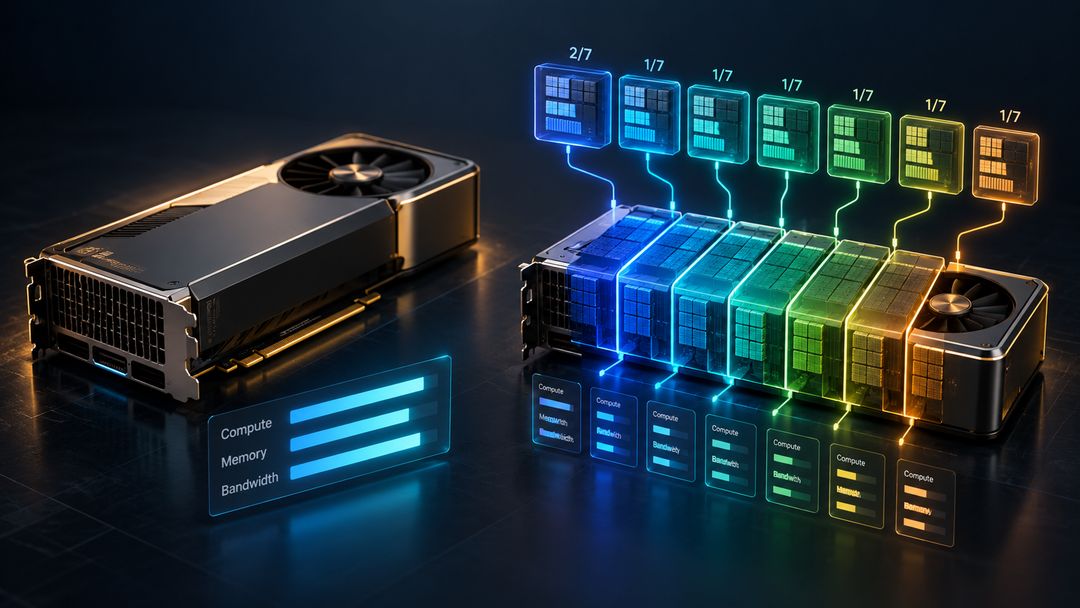
GPU slicing splits one physical graphics card into several smaller virtual GPUs. Each slice gets a fixed share of the VRAM and only a fraction of the card’s compute units and memory bandwidth.
On data center cards this is usually done with MIG (Multi-Instance GPU). An A100 or H200 can be split into up to seven instances, and each one gets a hard partition of streaming multiprocessors and memory. The naming gives it away: a “1g.10gb” profile is 1/7 of the chip with 10 GB of VRAM.
For providers, slicing is a great way to fill racks. For you it means something simple: you rent the name of a big GPU, but only a piece of its power.
⚡ Why Slicing Costs You Speed
Three things shrink when a GPU is sliced:
- CUDA cores. A 2/7 slice of an A100 gets 1,792 of its cores, not 6,912.
- Memory bandwidth. LLM inference is bandwidth-bound. A slice gets a matching fraction of the memory bus, so tokens per second drop sharply.
- VRAM. You get exactly the slice’s memory. Bigger models, longer contexts and larger batches simply don’t fit.
A full, smaller card often beats a sliced, bigger one. A modern Blackwell card with all its cores is faster than a famous data center GPU cut into sevenths.
📊 The Comparison: Classic Data Center GPUs vs. Trooper.AI Blibs
We compared typical offers from European classic data centers with the matching Trooper.AI Blibs. Each Blib has at least the same VRAM. For a fair price comparison, every classic offer was configured with exactly the same CPU cores, RAM and NVMe storage as the Blib it is compared with.
| Classic Data Center GPU | memoria de video | CUDA Cores (Classic) | Trooper.AI Blib | memoria de video | CUDA Cores (Trooper.AI) | Speed | Precio |
|---|---|---|---|---|---|---|---|
| T4 – 1/4 slice | 4 GB | ~640 | Explorer S1 · RTX A4000 | 16 GB | 6,144 | Faster | up to 56% cheaper |
| T4 – 1/2 slice | 8 GB | ~1,280 | Explorer S1 · RTX A4000 | 16 GB | 6,144 | Faster | up to 64% cheaper |
| T4 – full | 16 GB | 2,560 | Explorer S1 · RTX A4000 | 16 GB | 6,144 | Faster | up to 74% cheaper |
| A10 – 1/6 slice | 4 GB | ~1,536 | Explorer S1 · RTX A4000 | 16 GB | 6,144 | Faster | up to 61% cheaper |
| A10 – 1/3 slice | 8 GB | ~3,072 | Explorer S1 · RTX A4000 | 16 GB | 6,144 | Faster | up to 70% cheaper |
| A10 – 1/2 slice | 12 GB | ~4,608 | Explorer S1 · RTX A4000 | 16 GB | 6,144 | Faster | up to 76% cheaper |
| A10 – full | 24 GB | 9,216 | Ranger S1 · RTX Pro 4000 Blackwell | 24 GB | 8,960 | Faster | up to 73% cheaper |
| A100 – 1/7 slice | 10 GB | 896 | Explorer S1 · RTX A4000 | 16 GB | 6,144 | Faster | up to 69% cheaper |
| A100 – 2/7 slice | 20 GB | 1,792 | Ranger S1 · RTX Pro 4000 Blackwell | 24 GB | 8,960 | Faster | up to 65% cheaper |
| A100 – 3/7 slice | 40 GB | 2,688 | InfinityAI S1 · A100 (full card) | 40 GB | 6,912 | Faster | up to 61% cheaper |
| A100 – 7/7 slice | 80 GB | 6,272 | HyperionAI S1 · RTX Pro 6000 Blackwell | 96 GB | 24,064 | Faster | up to 36% cheaper |
| L40S – full | 48 GB | 18,176 | StellarAI L1 · RTX 4090 Pro | 48 GB | 16,384 | Faster | up to 32% cheaper |
| H200 – 1/7 slice | 20 GB | 2,048 | Ranger S1 · RTX Pro 4000 Blackwell | 24 GB | 8,960 | Faster | up to 65% cheaper |
| H200 – 2/7 slice | 40 GB | 4,096 | InfinityAI S1 · A100 (full card) | 40 GB | 6,912 | Faster | up to 67% cheaper |
| H200 – 3/7 slice | 70 GB | 7,680 | HyperionAI S1 · RTX Pro 6000 Blackwell | 96 GB | 24,064 | Faster | up to 36% cheaper |
| H200 – full | 141 GB | 16,896 | HyperionAI M2 · 2× RTX Pro 6000 Blackwell | 192 GB | 48,128 | Equal speed | up to 40% cheaper |
| RTX Pro 6000 – 1/2 slice | 48 GB | ~12,032 | RabenAI S1 · RTX Pro 5000 Blackwell (full card) | 48 GB | 14,080 | Faster | up to 37% cheaper |
A sliced GPU gets only a fraction of the chip: fewer CUDA cores, a matching fraction of memory bandwidth, and a share of the VRAM. A Trooper.AI Blib always gets the full card.
🔍 What the Table Tells You
1. A slice is not a GPU. An “A100 with 20 GB” as a 2/7 slice gets less than a third of the chip. Our Ranger S1 with a full RTX Pro 4000 Blackwell has five times the CUDA cores, more VRAM, and costs up to 65% less.
2. Full cards win on bandwidth. LLM inference lives and dies by memory bandwidth. A slice gets a fraction of it, a full card gets all of it. That’s why a full A100 or RTX Pro 5000 regularly outruns a much “bigger” GPU that has been cut into pieces.
3. Blackwell changes the math. Fifth-generation Tensor Cores with native FP4 and FP8 let a single RTX Pro 6000 Blackwell outrun even a fully allocated 80 GB A100 on modern quantized models, with 16 GB more VRAM.
4. Even the H200 loses when it’s sliced. A 3/7 slice has less than half the streaming multiprocessors and half the memory bandwidth, and no native FP4. A full RTX Pro 6000 Blackwell beats it on modern quantized models, with 26 GB more VRAM and up to 36% lower cost. Only the full, unsliced H200 is on par with two HyperionAI cards, and those give you 192 GB instead of 141 GB.
5. The L40S is a fair fight, and we still win. Against a full L40S, our RTX 4090 Pro 48 GB delivers higher memory bandwidth (around 1 TB/s vs. 864 GB/s), which is what counts for LLM inference, at up to 32% lower cost.
💸 The Hidden Cost of “Cheap” Slices

The slice itself often looks affordable. The bill doesn’t. Classic data centers typically charge separately for every vCore, every gigabyte of RAM and every gigabyte of storage. Configure a slice with enough RAM to actually load your model and the price climbs fast.
A realistic AI workload needs system RAM at least equal to its VRAM, enough CPU cores for tokenization and data loading, and fast local storage for model weights. Once you add those, a sliced GPU is rarely the cheap option.
| Cost factor | Classic data center slice | Trooper.AI Blib |
|---|---|---|
| GPU | Fraction of a card | Full card, bare-metal |
| CPU cores | Billed per vCore | Included, dedicated |
| RAM | Billed per GB | Included, dedicated |
| Storage | Often network-attached, billed per GB | Local NVMe up to 7.5 GB/s, included |
| Setup fees | Common on bare-metal offers | Ninguno |
| Billing | Often monthly or long terms | Hourly, weekly or monthly |
🇪🇺 How Trooper.AI Gives You the Whole GPU

Trooper.AI rents EU-hosted GPU servers, operated from Germany, with full, bare-metal GPUs in every Blib. No slicing, no shared silicon, no noisy neighbours on your card. From an RTX A4000 to four RTX Pro 6000 Blackwell cards with 384 GB of VRAM, you always get the complete GPU.
Key benefits include:
- ✅ 100% bare-metal GPU, CPU and RAM
- ✅ Local NVMe storage with up to 7.5 GB/s
- ✅ 99.6% availability SLA for business customers
- ✅ EU-hosted, GDPR DPA signed in one click
- ✅ Full root access and one-click AI templates (vLLM, OpenWebUI, ComfyUI and more)
- ✅ Hourly, weekly or monthly billing, plus reserved Blackwell capacity
Configure your full GPU server now →
Preguntas frecuentes
What is a sliced GPU?
A sliced GPU is a fraction of a physical graphics card, typically created with MIG or vGPU profiles. You get a fixed share of the VRAM and only a fraction of the CUDA cores and memory bandwidth.
Is a sliced A100 or H200 faster than a full modern GPU?
Usually not. A 1/7 or 2/7 slice has only a small part of the original chip. A full, modern card like the RTX Pro 4000 or RTX Pro 6000 Blackwell delivers more CUDA cores, more bandwidth and native FP4/FP8 support.
When does a slice make sense?
For very small, bursty inference tasks or virtual desktops where a fraction of a GPU is enough. For LLM inference, fine-tuning or image generation, a full card is the better choice.
Does GPU slicing affect LLM performance?
Yes, significantly. LLM inference is bound by memory bandwidth, and a slice only gets a fraction of it. Tokens per second drop roughly in line with the slice size.
Are Trooper.AI GPUs ever shared?
No. Every Blib gets full, dedicated bare-metal GPUs, CPU cores and RAM. Nothing is sliced or shared with other customers.
What’s the best first step?
Check how much VRAM your model needs, then pick the smallest full-card Blib that fits. You get the whole GPU and can upgrade later without reinstalling.

Last updated: September 2026. Comparison based on publicly listed offers of European classic data center providers (September 2026), configured with identical CPU, RAM and storage as the matching Trooper.AI Blib. Monthly billing. Speed ratings are our assessment based on CUDA cores, memory bandwidth, architecture and our own TAIFlops benchmarks.
¿A QUÉ ESTÁS ESPERANDO?
Alquila tu propio servidor con GPU hoy y comienza a construir aplicaciones de IA increíbles! Los servidores GPU de Trooper.AI están construidos con tecnología high-end reciclada al 100% de los últimos años, diseñados para ofrecerte el mejor rendimiento, seguridad y confiabilidad en todas tus necesidades de IA.
Alquila un servidor de GPU para IA
Ubicación en la UE · Alta privacidad · Alto rendimiento · Mejor soporte